March.

It’s a slow tidal wave. But at least I can see it coming now. (Wait. . . is that better?)

March came and I found myself crying in the car again. Every time I was alone in the car, I was crying again. We learn quickly in grief that what feels like regression is just another wave. I thought to myself, “why am I crying in the car again.” It took a few days and I realized, it’s March. Last year, I was settling in to the last month and a hlf, 2 months. I was slowing down. Going into the internal state of pre-labor, pre-baby. Where there is so much blood and so little room in your body that everything slows down. There is a physiolocy and psychology and spirituality to these last months and weeks of pregnancy and my body was just remembering and my emotions were just responding because . . . still no baby.

Today I openly cried in three public places. The memorial tree planting, the kids indoor play place and, my all time favorite public crying venue, the grocery store. It was like the early days of my grief. The days when it just runs over and we still need to eat so I cry in the car on the way to the store and I cry while I push my cart and fill it with food I can hardly taste anymore. And I am met with wide eyes or avoidant glances or a checker who, wisely, doesn’t ask how my day is going, but focuses intently on her job and getting me gone. There is a freedom, though now, because I am also not afraid to cry and have begun to find it strange that more people aren’t just openly weeping as they go through their day. At first, I didn’t care what people thought or how I might be percieved. I didn’t have the energy. I needed to cry and we needed food and that’s all I could do at once. And I found today, that I still don’t care. Crying in our culutre is treated as something that needs to be stopped or fixed or avoided. Not so when your newborn son died. Crying is a means to an end, at best, and a necessity, at least. It is a way to move the heaviest, most impossible energy, grief, out. It’s a release valve. I want to ask each person who stares or avoids or ignores what they would imagine it would take for them to open cry in public, outside of bodily injury or assault. These are not tears that are asking for help or needing to be stopped. They are the physical manifestation of emotional overwhelm, of energy moving somewhere, anywhere else, out.

All of that said, I don’t really cry in public anymore, or alone in my car that much really either. So the last couple of weeks and today have taught me a new barometer about the waves of my grief, how big they are, how close or far away, if I’m surfing or drowning or bobbing. March is bringing this slow tidal wave of grief and so I am crying  in front of strangers again.

I’m also remembering, seemingly with no conscious thought of investigation about the things that I was doing at this time last year. Today, I planted trees for my dead baby. Last year on this day, I split an irish coffee with Jenn at Huber’s and felt rather scandilous to be drinking at the end of my pregnancy. I remember the walking around looking for a place to brunch, the sun shining as Vesta ran up and down the street as we waited for a table and M toddled behind her. I remember our husbands came out and traded places with us. I remember the strollers were hard to negotiate and tuck away in the dining room. I remember the service was wretched and the food was terrible but I also remember I was happy. In an irritable, grumpy pregnancy, I remember feeling pretty happy being with my family and getting ready to get ready for Baby Brother, as we called him, to come.

I got an email today from Vesta’s school about the play the grade classrooms will be preforming. I remember waddling in last year, before Vesta was even enrolled, to watch the older children preform Snow White and Rumplstiltzkin and one other fairy tale. I remember sitting on the floor in the front of the room and Vesta trying to sit on my non existent lap. I remember wanting her to feel comfortable here since she’d be spending so much time here, away from me for the first time, and I with her little brother. I was relieved how comfortable and interested she was.

Last year, at Easter, I decided to make a big deal of it. Vesta was really into fance dresses so I bought her a new one, made her a basket and we hid the eggs we colored and hid them all over the house. She was delighted Easter morning to learn about the Easter bunny and all the treasures he had left her and the game of seek for the eggs. I remember feeling this was an important day. One of our last with just the 3 of us, a new tradition for our family that he would enter into next year. This year, I want to avoid the whole thing. Pretend it’s not happening. Pretend nothing has happened.

There are a million other things about the next couple of months, the next several weeks that will come to mind without any searching or wondering or forethought. Theses are the schools of fish and the seaweed and even the debris in the tsunami that is approaching. Our experiences live in our cells and grief is a vehicle that brings them out. People talk about years after the loss of a parent or sibling or friend that they feel sad and tired and sluggish before they even realize it’s an anniversary approaching or already here. But, true to form, out of either detemintation or stubborness or being human, I’m going to do all of these things anyway. We’ll do Easter without him and the school play with out him. We did today with out him and we’ll do tomorrow without him and everyday after that. We’ll learn to live with the waves that lap at our ankles and the ones that bowl us over. We’ll learn that grief always has surprises, that at least first and I imagine anniversaries are never what we imagine they will be. Grief is a dynamic process. One that like our lives and our stories doesn’t stop until we do. It reveals things to us through suffering and numbness and even joy at times. It’s a constant companion that is quieter now, it is not always yelling in my ear or wrapping it’s arm around me. But it’s always there. And this month and next, we will learn new levels of each other I’m sure.

Trees.

I’m going to plant a heart in the earth
water it with love from a vein
I’m going to praise it with the push of muscle
and care for it in the sound of all dimensions.
I’m going to leave a heart in the earth
so it may grow and flower
a heart that throbs with longing
that adores everything green
that will be strength and nourishment for birds
that will be the sap of plants and mountains.

– Rosaria Murillo

IMG_7489

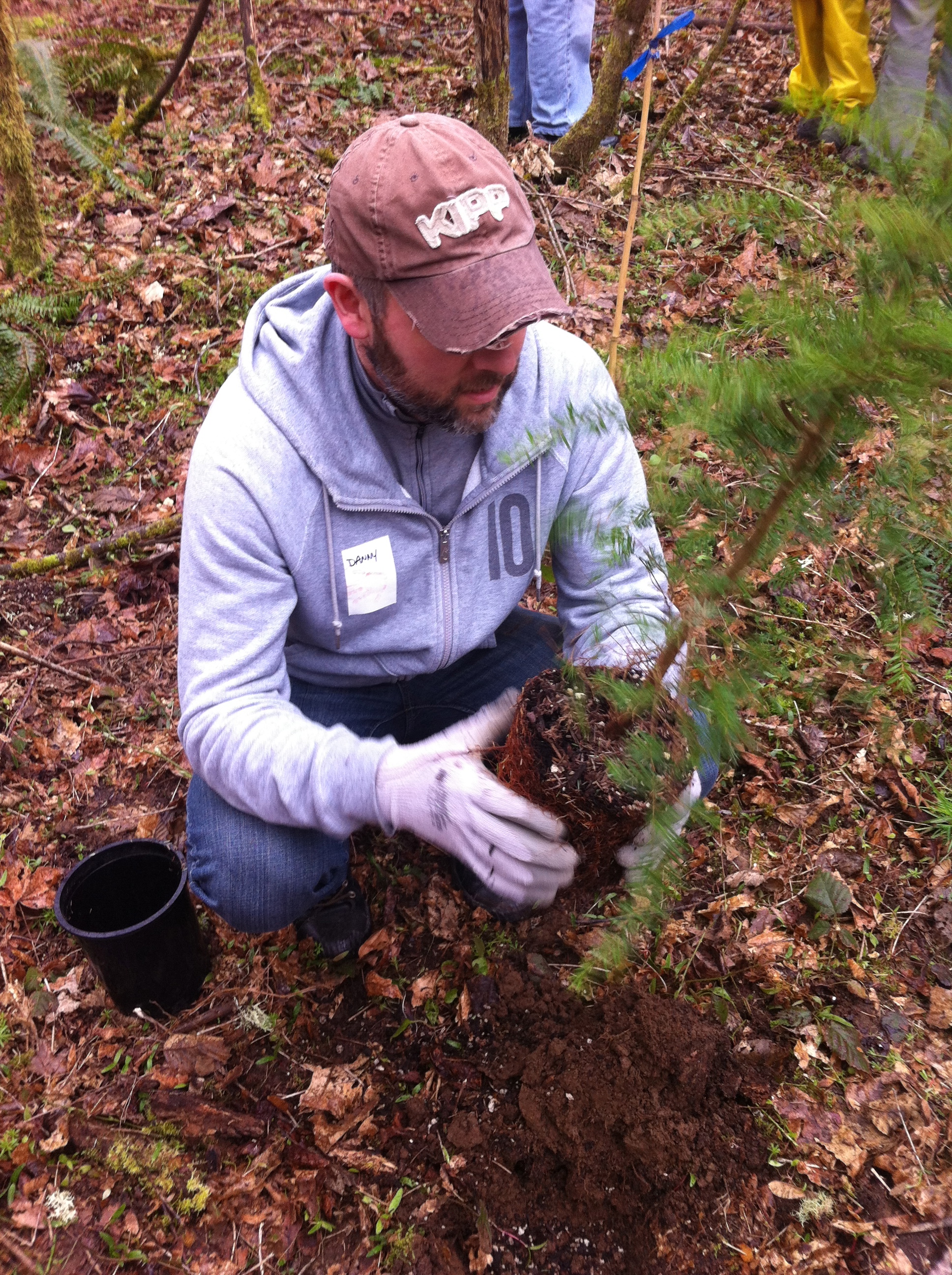
Today, we planted trees.

Shortly after Harvey died, we got a card in the mail that my new bosses, at the spa I’d just begun working at 3 months before, The Barefoot Sage, had donated to Friends of Trees in his name. Not too much later, we got another card from coworkers of Danny’s in San Francisco that they had also donated to this organization in memory of Harvey. I learned later that we would actually go and plant these trees ourselves.

I’ve also learned over this last nearly-a-year that relationships change after a child dies. That people who we were once close to, become distant and sometimes disappear entirely. That some relationships cannot sustain my inability to communicate regularly, that I do not have the energy or desire or will to maintain others that were once very important to me, central even. That some will keep calling and texting and sending gifts even with little to no response from me for weeks and months and sometimes never and maintain the relationship for me, completely one sided because they know, someday, I will b back. That those relationships closest to me become deeper, become strained, even out again, feel like old times, need to figure out new ways to be, ebb and flow with my grief and my process. That there are people who come out of the woodwork, who have been in my life peripherally or are relatively new but  who all of the sudden become beacons and support beams. My “boss” Cuqui became just that: someone I just met who and known forever. Who I’ve canceled on, never gotten back to, forgot to do what I’ve promised, and in return she sends me little notes at least weekly, brings me lunch only to find me in a puddle of tears as I open the door to greet her and then listens to me for hours never getting to the lunch she prepared, writes encouraging words on my Facebook posts, never rushes me and always expects me to be exactly how I am, whatever that might be. She is a pillar of light in my dark world. Her gifts seem never to stop coming. Her presence and patience perhaps the most valuable among them.

So today we go to plant trees together, nearly a year later. We get lost getting there, I get teh car stuck in the mud and also manage to be halfway into the street. We have two tired girls with us, who don’t really want to hike and dig in the wet cold. I arrive flustered and irritated and it’s only 9am. We gather to listen to the organizers, who thank this one and that, talk about the mission and then mention that many of us here today are here for someone who is no longer with us. I’ve been herding the girls, while Danny has run back to the car for warmer clothes for them and all of the sudden there is Cuqui as the poem is being read and I am crying because my baby died. Because I’m standing out here and I don’t want to plant a heart or a tree nor give it my vein nor my muscle. I want to be herding my toddler too. I want to spend March 16th planning his first birthday, because he is here, not planting trees because he’s gone. But what else am I going to do but try every damn way to honor him, every way to fill this nearly 11 month whole in my life where my son should be. I don’t want this to bring Cuqui comfort. I don’t want her to believe that this is helping me because it isn’t. Because it’s the same as the altar and the Facebook page and the 6 month ceremony and the tattoo and the jewelery. It’s empty. An attempt to fill this unfillable void, to heal this fatal wound. I want to tell her and the lady reading the poem that this whole thing is an empty charade and nothing will help.

Except what I do is lean into her and cry. She saw Danny go, heard the woman start talking and floated over to hold me up just before I fell over. Again.

This healing, the slow stitching up of this wound, it doesn’t look anything like anything else I’ve ever been through. I spent the rest of the day in a stupor of awe and gratitude for all that she and her partner and her business brought to my life. How my little fetus son, walked me into that place and then insisted I get connected there. I applied, then emailed, then emailed again, then had a friend put in a good word until I finally got an interview at 7 months pregnant, not able to hide it anymore, sure they weren’t going to hire me and then they did on the spot. I worked there for 2 months and then my kid was born and died and I never went back. Except they kept gifting us time there as clients. She kept messaging me and staying connected and gently reminding me that she was always there. So, I went back, again and again.

So, I stand there with her arm around me, back in protest that any of this is happening, and it feels like the wound is tearing open again, but it’s not. It’s healing up a little more, it’s just that the healing hurts, too. It’s that this is both empty and full. It is both heartbreaking and healing. It is both meaningless and the most important thing to do. Just like everything else now. It’s both: everything and nothing. Never simple anymore.

We meet up with our group. Our group, of course, because this kind of thing always happens now, is represented by a child’s handprint. I laugh to myself “This must be the dead baby group”. But no, we go around and introduce ourselves and everyone is there for their grandmother or their elderly mother and we are there, and my husband says for us, for our son who died and Cuqui says, we are here for Harvey too and I barely choke out my name.

We hike down and we talk and joke and laugh and take care of the whining children. We get to the site and jab our shovels into the soft earth, step on them and wiggle them around. We do this in a square, inviting the girls to do it too, and dig up the earth and look for worms and shake the plants out of their pots and tear apart their roots and bury them and pray that they will live. I at once wish we had brought some of his ashes to plant here and tell myself I’m never coming back here. I can’t bear it if one of these plants dies. If I buried the root collar to deep or didn’t pack it tightly enough or not fully spearate the roots and I come back to find dead trees for my dead baby. And then I think, “Let’s do this next year. Let’s come hike here and watch these trees grow over the years and teach Vesta as she grows about xylem and floem and conservation and survival of the fittest”. And then I think, these stupid trees get to live and my kid died and I don’t want to plant a single one. And I jab and step and wiggle and look and shake and tear and bury and then do it again.

And so do Cuqui and Sue. I imagine them now, just doing the work, enjoying it, finding meaning, being the stability to our choas. Sue finds a “raised bed”, a fallen log covered in the softest pillow of moss any of us has ever felt and plants a baby tree right on top of it. We use it as a marker, so that when we come back, we can find Harvey’s trees. And it means everything. And the healing hurts less for now. There is a marker now. A place to come to. Where people who loved him came on a Sunday morning and hiked and dug and planted and cared for a whole grove of trees. Because that’s what we humans do. We heal. Even though it hurts.

IMG_7492

Back.

I just want to go back

and wrap my toes around

the cold white metal

of the table’s legs


and curl up in the sunshine

under the Crayola red, down comforter

and listen to the crinkle of the Times

and day dream


I want to go back to when

the future laid itself out to us

only in our minds

when we had nothing but potential


I want to go back

before all the gray hair

and the belly hanging over

and the age on your elbow

and the grief.


I want to drive to San Francisco

without stopping and with butterflies in my stomach

to see you again

and taste what the city. . . this life . . . you . . .

have to offer me before it’s even in my mouth


I want to hit reset

Start over

Call a do-over

and be young again

and worry about things that don’t matter

but feel like they do.


I want to relearn,

I want you to teach me again,

that everything’s going to be okay

without my later being able to say,

“I told you so”.


I want to be young again

and twisted up together

wound around in newness and love

and not contorted in your arms

trying to put everything back together

the pit of my stomach saying it’s all just too broken


So, let’s go back there.

I close my eyes as you lay in my arms snoring

like you did when we were kids

and I pretend and I will myself back there

back before weddings and children and lies and loss

any time with you, any moment

before this loss

before this life of ours kept crashing us against the rocks

before this,

when we knew how to swim.


I close my eyes and there we are

in the apartment with the red table with the metal base

and the Murphy bed with the red comforter

and we don’t know yet

and we don’t know yet

and we don’t know yet.


and then back here,  I squeeze squeeze squeeze them shut

and I will myself to sleep before they open again in this darkness

in this same town, only hipper

in these same bodies, only older

in this same loss

in this same loss


and we don’t know yet.

Taxtime.

It’s tax time. TIme to talk to the accountant, a man who has been “in” my life for 8 years by now. We have email exchanges February through April and speak on the phone once a year. But we are fond of each other. We are professional and to the point, but he knows about us. Money, books, taxes all tell a story and this year our story is a sad one.

So, the time came: The email reminder in late-January to get things together to send off to him, the getting together of documents, the faxing, the attaching files, the calculating of mileage, the telling of our dead son and asking about the child tax credit, the one-time child tax credit we are extended for our only son. It was easier than I’d imagined. I think about the poor “guinea pigs” in my life who had to endure my first, awkward, clumsy, heart wrenching confessions. And here we are, at almost a year with each regular,  professional person in our lives knowing, except our CPA. He gets the benefit of the email format and also the relative expertise I have gathered in 9 months and 3 weeks.

Picture an accountant and that is ours: Thick rimmed glasses, thin and lanky, socially awkward, straight to the point, kind and endearing. Part of my fear of telling him is my fear of him not knowing what or how to say, because of the strangeness that follows nose in computer day in and day out, the strangeness that often accompanies a “numbers guy”. No one knows really what to say and then we have this superficial intimacy in which he cares but doesn’t care, knows us but doesn’t know us. But, like so many others, never having been in our position, he answers my email perfectly. He answers quickly, certainly just after he receives the message and he answers by writing exactly what he would say:

“I’m so sorry…..I’m…..so sorry.

Um….did you get a social security number for Harvey?? How much in medical costs did you pay in 2013? Guess????

I’m so sorry you are such a wonderful person life is not fair sometimes…”

There is so much comfort for me in these ellipses, in the spaces between his words that are where the real truth is hidden in the spoken word. That are exactly what he is thinking. They fill in, more prfoundly than the space bar would, just exactly how there are no words. That he includes the pauses that in speech says more to a bereaved parent than any words. That he then wrote “Um…” like ‘I don’t even know how to proceed but I have to ask these questions’. Like there is no way to lead into the business questions after learning about this. Exactly what he would say if he was speaking me to me : “um…”. He tells me that I am a wonderful person and life is not fair. He knows me but he doesn’t know me and his telling me the truth, his truth, my truth, the truth of this moment. Life is not fair, bad things happen to good people and all the other cliches we tell each other and ourselves for some comfort or consolation. Sometimes they work and sometimes they don’t and this time they do.  My accountant of 8 years who has seen my business flounder and then succeed, seen us married, become parents, my eclectic education, cars and computers depreciate, move to a different state, start my business over again, and now lose our child, can just tell me the truth. Can just sit in his apartment in San Francisco, preparing for another year of endless late winter/early spring days, receive this email with this horrible news from someone he knows mostly on paper and simply tell the truth.

It’s all I need to hear. I realize it’s the words, the ellipses, the mimicking of speech that make this one of the most meaningful responses I have received and it is also none of these things. It’s the intention behind the words, it’s the time it took, it’s the documentation, it’s the saying even though there are no words, it’s the effort and desire to help, see all those question marks? The truth, the humanity, the helplessness, the floundering to be able to help in some way all of this is found not only in the words but in the punctuation, in the space between.

It’s also that he is the last person on the list. I will tell many, many more people about my son and I will not tell even more people when they ask me how many children I have and I lie. But I collect moments now, firsts and lasts, endings and dreaded, new beginnings. And I am grateful to this man that I know but don’t know for making this one count, not just to me. But mostly to me. Because he will forget what he wrote, probably already has, but I will remember. I will always remember.

Animal II.

I wrote once of being an animal. My connection early after my loss to the wild kingdom. How primal an experience, how “left to the elements” I felt. I longed then to be the careless animal who leaves, at best, or eats, at worst, her dead young. I was instead the opposite. The animal who would have willingly taken his place. Who nudges and and barks at with the persistence of the unbelieving. Who then begins to wail and hollow sounds not of this earth.

I am better know. Minutes ago, I was the animal mother standing over her dead baby. Her herd standing around them both, all mourning, like the elephants and dolphins. I am the mother who moans my animalian voice, my herd beginning to disperse. I remain as the last of them trudge on together. I wait until the last moment, danger in the air, sensing exactly how far away I can be from them, how close I will allow the danger, how desperate I am to stay above him forever. How I have no way to properly care for his body. I know I mustn’t let them get too far but I can’t imagine just leaving him there in the dirt, for the vultures and the sun to dispose of. Minutes ago, I was that mother. And now I am the one who can wait no longer. Who’s life becomes threatened if she does not move on with her herd. In isolation, she will surely perish. Now, I am the mother who knows the danger is too near. That lingering any longer will lead to certain death, to being swallowed up. Now, I am the mama animal who backs away from her dead young, whimpering and wailing, to rejoin my herd. Leaving my baby there because whether human or animal, claws or thumbs, there is no way to properly put to rest your baby’s body. Human or animal, there is no sense to be made.

I am rejoining the herd because I have to. Because I have survived and he has not and that means I must keep going. There is nothing to be done. The animal desire to survive is too great to lay down next to him. The fear of being swallowed up by the predator too intense to entertain. I must give up and surrender and keep going. So, I begin to back away, keeping the distance of the herd and proximity of the danger at the front of my awareness, so that I do not leave a moment before I must. I back away, dust billowing around my feet as I step, drinking in the smell, the sight, the bend of the light. I back away until I must turn around and prepare to run.

Now, nine human months later, just a few, short animal minutes later, I am beginning to turn around.

Grieving Penguin video

Christmas.

Dear Harvey,

Well, it’s Christmas. We have made it this far without you. Everytime I write the date, even months ago, I would marvel that it had been that long. That time didn’t actually. stop. That now it is September, Novemeber, December, Christmas.

As I buttoned Vesta’s Christmas dress and helped her step into her tights, I wondered what you’d be wearing. I wondered if I would have gone the cute sweater vest and button down shirt, little-boy-dressed-like-a-man route or a “Baby’s first Christmas” onesie. I continue to marvel at the ease with which I move around in the world, especially since Vesta is so much more independent, dressing herself, climbing into her carseat, getting food from the fridge. Without you here, I just grab my purse and go. I sleep through the night. I stand around the island in the kitchen, virtually uniterrupted, and talk to the grown ups. Relatively no demands for me to be anywhere else anymore.

As I’ve been told, the anticipation of the holiday is worse than the actual holiday. We had two babies to come home to, having not been back to my upstate New York home since you’ve been and gone. I dreaded it. As time grew closer, I lamented my choice. Since I moved away 13 years ago, I’ve never not wanted to come home. I always greatly look forward to it. Now, I just want to retreat to a cave. Especially, at Christmas. Especially, with the babies here I so wanted you to meet. I had envisioned the three of us posing for a photo with our three babies on our lap in front of the Christmas tree. All smiles.

But it’s normal here. Everyone is doing their normal Christmas things. There is an  adjustment here or there but nothing major. In some ways, it’s nice. It’s nice to leave my daily life of loss and sorrow and come back home to find my family relatively unscathed, still doing what they do, what they have always done. I don’t mean to sound dismissive or condesending but I’ve always thought of life here as relatively simple and easy. And it seems to continue so. I visited my cousin and her new baby and it was nice to be in a normal newborn home: everything a bit amiss, baby contraptions everywhere, cozy and warm and geninuely happy and tired. It’s nice to be with both cousin’s families with new babies to remember and see and be a part of what happens when the baby doesn’t die. I begrudge them less. Since I had it with Vesta, I remember how it was and it feels good to revisit it after living in such tragedy for all of these months. It’s refreshing to be around these families with new babies who still get to have the love without the loss, the innocence and naivete around their pregnancies and new babies. That they got what they were supposed to get, what they planned happened, even if it was not exactly what they planned. It’s refreshing to be around my family for whom everything is still going right, for everyone here in New York whose lives haven’t been completely derailed. It’s kind of like in Mexico: it feels less real here. Except, of course, when it feels exceptionally real.

I sat and held baby G for two hours the other day. You loom large in my mind: heavy and big like a 3 month old, even though you weren’t. I see pictures of us holding you and I think “He was small”. It wasn’t your presence or energy either, as I never felt you here very strongly at all. It’s something about your physicallity and my memory. Like in the movies when they hold up a clearly 6 month old baby to the actress who has just pretended to give birth.  G is impossibly small, the size at one month that Vesta was when she was born. a whole pound less than you when you were born. She doesn’t look or feel like you. Other bereaved moms have told me, most of whom were terrified to hold a baby after theirs died, that once you are with the baby, it is not bad, it can be easy, it can even be healing. Because this is an alive baby who is not yours. Your heart swells and you’d still throw yourself under the bus for this baby but it’s not your baby and certainly not the person who was inside your dead baby. I held her and watched her and touched her head and felt  her weight in my arms and examined her feet and fingers, her long legs and her skinny arms. I can hold her and I can love her even though she is a baby. Even though her family gets the happy ending that is an alive baby and I do not. I can hold her and meet her baby cousin and ooh and aah and coo and coddle and these little babies can stitch up a part of wound. They say to me, “It’s only me. Someone different and unique in the same sized packaging.” and I hurt less. Or differently. I hurt more for Harvey and less for “my baby”. I grieve deeper for the singular person he was, who he doesn’t get to be, who I don’t get to know. Turns out that behind the fear and anxiety and trepidation was a salve, a truth. It’s not all babies, just mine.

At Christmas, I took a Xanax and a deep breath and walked in to my uncle’s house, full of people who love me more than anyone on the planet. People full of grief for the baby I am not bringing in. Full of not only their grief but that wretched helplessness that comes along with grieving with your loved one who is most affected. Full of people who don’t know what to say or do and so just say and do what we always do. Full of people who will do their best in this worst circumstance. I did my best, too, and we were with the babies within minutes. My little nuclear family quickly curled itself around their little nuclear families and we passed the two babies between the three of us. Your sister was a pro without a moment of practice. She sat so still, made sure she held their heads and wanted to be nowhere else but holding them. If she wasn’t holding one of them, she was asking to. She would hold them, touch them, coo at them, tell me about their small eyes and whispy hair. I was so proud of her, displaying that level of caution and reverence for such little beings without ever having been so close to one before. It was also devastating to see what she couldn’t see: what she had missed, what she is missing without you here. I didn’t know how she’d be as a big sister but this ease, this naturalness, this pure urge to hold them, is not at all what I expected. If you were here, of course, not every moment would be like this. But there would have been this moment. Daddy placing you in her arms, holding your head for extra support, while she looked down at you and smiles and I stood back to capture the moment of your first meeting. When she bounded in the house from being with J during your birth like she was and called “where is he?” . Your head would turn to hear that voice you knew so well, now so clearly, just like I did when my brother arrived to meet me. The swelling of my heart with pride for the my little girl and the simultaneous breaking of my heart for my little boy. I am getting used to this now. Or should be, at least.

We fell in to the normal questions, to the normal catching up with adult family members, with the normal gorging of ourselves on Italian meats and cheeses. I was living right on the surface, have been since I got here. I can’t go down very far or I am sure that I will explode into a million pieces. Just being where I grew up, the snow and the river, the warmth of my uncle’s house, the unmistakeable smell of home at my dad’s, the smiles and laughter of my cousins, the gentle squeeze of my grandmother’s hand on a forearm, just being there without you, too much to fully experience. So I stayed on the top, with medicine and booze and sheer will. Until your Nona, your sweet, sweet Nona, came to me to ask how I was doing and it came out. Not all of it by any means, but all of the effort, known and unknown that it was taking me to keep it together was toppled. I just leaned into her and started crying and she said comforting words and my Grandmother came over and rubbed my back and said comforting words. And because of those babies, because of my cousins’ faith in me, I cried perhaps for the first time, at least for the first time in a long time, for YOU. Not for all of the shenanigans that grief commits on a parent. Not anger at others and deep sorrow for myself. Not being able to look at other babies or new moms in the eye. Not being unable to be happy for anyone else because I am so sad for myself. Not begrudging others for doing nothing wrong except loving and celebrating their living baby. Not jealousy, anger, frustration, betrayal. Just you. Just my loss. Just your absence. There was a purity there now. There was none of the crap that gets piled on from daily life after losing a baby. There was just the love of our family and your absence from it. I was alone inside myself without you. And there was a sweetness. There was a freedom now in my grief, in my longing for you. There was a revealing of a truth. I caught a glimpse of it after G was born safely. It was a long forgotten clarity from the first days and weeks after you died. “I want my baby.” Pure and simple. I want my baby.

___________________

I visit my Grandma in her knew home. She had a fall and is now living in a nursing home. She wants all of her new friends and the staff to meet Vesta for the first time. As she parades us through the halls and the cafeteria she says, “This is my great-granddaughter, Vesta. My namesake.” Then she smiles wider, raises four fingers and says “I have four great-grand daughters”. This is true and it’s not true. She has four great granddaughters and one great grandson but he’s dead. I am hurt that she doesn’t just say “5 great-grand children” and I am grateful that she says “daughter” and not “children”. I wonder if one of the babies was a boy, as she was expected to be, what she would say then? This is a convenient out and it sticks in my craw and she says it over and over and over. But as I ruminate about it over the following days, I know that I appreciate her position. All too well, really. No one knows how to talk about a dead baby, not even an 87 year old woman who lost her mother at 13, who’s twice widowed, who’s best friend lost an adult child, who’s seen and known plenty of grief. Even she plays verbal games to avoid talking about my son. I condemn her at moments in my mind. Until I realize that I am holding her to a higher standard than I hold myself. I routinely lie you away. “How many children do you have?”, “Is she your only child?”, “Do you have any other kids?”. More often than not I say: “1”, “Yes” and “No”. I also play the same game she is playing, tell the truth but not the whole truth: “Do have kids?” “Yes, I have a four year old daughter”. In all instances I shift my weight and do the unconsious, characteristic lying behavior of briefly looking away. But, at the end of the day, I am the same as her or worse, since I am your mother. I do what I can to avoid telling people about my so who is dead. I do verbal gymnastics and lie and tell half-truths because I don’t know how to say it and I don’t how to react to their reaction and we’re not supposed to talk about it still. And there remains a part of me that wants her to stand up for me, for us. To say it anyway, to be stronger and more brave than I.

My cousin texts me later, after we’ve returned to Portland, and says “Gram is going around the nursing home saying, “I have four great-grand children and an angel.” I am grateful to hear that. Maybe I can say that with some regularity too someday.

_________________

Just like everything else now, being home was all things: It was wonderful, exhausting, heart wrenching, bolstering, renewing, impossible, healing and hard. It takes so much energy to stay on the surface, become coworkers in our parenting and just get the job done. Just stiff upper lip it and get through it. I very consciously and with effort stopped  living my life like that some years before you died. Now, at times like these, it becomes a survival mechanism, a necessity, what makes the most sense. Sometimes we have to grin and bear it and we do. And we come home wide-eyed and exhausted, wondering how we got through, wondering what’s on the otherside. More of the same? There wasn’t much to look forward to coming home too. There never is anymore. Where ever we go, you are still not here.

Markings.

I’m a mile marker now. First it was days since you died, then I counted weeks. Somewhere along the way I lost track of weeks and now it’s months and half months. Significant days are heavy and long and anxiously awaited (waited for with worry, nausea, and a racing heart, I mean). I make them up. I mark them. I attempt to make meaning. Every 27th and 28th of the month, 6 months, then holidays and special events.

I cried through most of Daddy’s birthday because I missed you so much. Sometimes your absence is too much to bare. L came over to watch Vesta and we just easily put our coats on and headed out. No baby to time nursings with, no hiring of a babysitter because it’s too much to ask my friend’s to take care of both kids, no just not going because I can’t manage the arrangements and the everyday of two kids and work and, and, and.  .  . . We went to The Barefoot Sage and cozied up on the big couches for foot soaks and massages. It’s decorated so beautifully for winter and the blinking lights of the tree just took me down. I began to understant what the grief people mean by just canceling the holidays the first year or how they are so hard. I didn’t think I would be much more affected than any other of these days I or we collectively put weight to. I don’t even like Christmas. Your first Christmas was not high on my list of “firsts” I was looking forward to, so I didn’t think it would be heavier than any other day or couple of weeks. But, as always, they are right.

Sitting quietly next to your dad, without you here, just overwhelmed me. I don’t really know how to describe it except that sometimes I can feel the piece of him that is missing as much as I can feel the piece of me. The empty, endless, painful void where you were supposed to be. Sometimes he wraps himself around me at night and I can feel his heart beating on my back and I feel you in that beat and I also feel the chill of your beatingless heart just after you were born and then again, the next day, in my arms. I stand just at your dad’s chest and we are prone to long, standing hugs these days. I place my ear there at his chest as he holds me and I hear that strong beating and I hear you, too. How can he be standing here, a grown man, long legs and silvering hair, heart beating the same all of these 40 years and you? You are just gone. His mom got to keep him, I get to have him here and you are just gone and I am lost.

I am becoming so aware of the parts of you that were your dad’s, the relationship that would be there but that isn’t.  And now is about the time, isn’t it? Time when the baby really starts coming into the world, scooting along the floor, engaging those around him with new sounds and abilities. I can hear your squeal and see your face light up when Daddy steps in through the door at the end of the day. It’s not just you that is gone. It’s who we would be with you here. It’s the missing relationship between you and me, you and your dad, and you and your sister. How one person creates a whole new matrix of energy and relationships and experiences. How now our matrix has changed because you are not here. For better and for worse. For much, much worse.

People say that we’ve lost our hopes and dreams for you. That’s not it at all. Hopes and dreams get lost and we mourn them and then we change them. I’ve lost hopes and dreams before. But that’s not what has happened this time. This time I’ve lost my baby. Fully and perfectly formed, ready for the world but for his mother’s malfunction. This time, I’ve lost my baby, my toddler, my school aged boy, my college freshman, my adult son who might or might not be a husband, a father, with a career and hobbies and passions. Who wraps his arms around me as an adult, his 40 to my 75, and I hear his dad’s heartbeat as I lay my head on his chest. These are not hopes and dreams. This is the loss of the most precious relationship one can have,  the most important person. I can dream again, reinvent, recreate when my dreams are lost. There is picking myself and dusting off, no starting over, revising, counting my blessing, finding the silver lining and moving on to a differnt dream from this.

The harrowing realization that this is every day. Everyday for the rest of my life I will miss you and think about you. I will imagine you and long for you to be here. Makes my days on Earth feel endless, the years ahead almost inconceivably long, as if I will live forever. I know that when I close my eyes for the last time, the relief of the end of longing for you will be the sweetest sense. I am not afraid to die anymore.

Today, I thought that it’s almost eight months, which means it’s almost 9 months, which means soon you will have been gone as long as you were here: 41 weeks and 2 days. I remember when my friend Theresa died at 16. I remember 16 years later when I thought, “That’s it. That was her whole life, again. She’s been gone as long as she was here.” and I wondered how her parents felt, what they thought about that. Now it’s 18 years and 4 months later for them,  7 and half months for me and I want to call them. I remember feeling so connected to their loss, like we understood each other. Now I know that I wasn’t and I want to call them and say I didn’t understand that then and apologize for whatever horrible things I might have said. I was 16, too, and it was all about me. I went to her mom for comfort. We drove down there by the car load and sat in her room, read her diary to her sister’s excruciating protests, that her mother then had to manage and attempt to comfort in the midst of her own debilitating grief and parenting a grieving sibling, instead of just sending us out. We sifted through her things. Her mother made a special day where she invited all of Theresa’s friend’s and put her things on tables on the patio and we sorted and sifted and took things home with us. How did she ever do that? How did she go through her teenaged baby’s room and pick and choose what to keep, what to give to family and friends and then what do you do with the rest of it? Do you donate it, throw it away, pile it in boxes in the basement? That’s what I did. I have years of little girl clothes and all of Vesta’s infant stuff: bouncers and seats and toys and play mobiles and bottles and pumps and a food mill and tiny pink spoons. I have a full year of boys clothes, too. Hand me downs from a couple of families and new stuff given and purchased and replaced for Harvey. I packed it all up and organized it and labeled it because, before the surgery, we might have another baby and we wouldn’t have to buy anything. Who’s to say if it will be a boy or a girl, so keep it all. Now, most of our storage space is taken up with stuff waiting to be used by someone who will never come.

I want to call Theresa’s mother now. I want to hear her voice: how happy it is to hear from me and how I can now hear, with exquisite accuracy,  the part in it that will always be broken. I want to say to her, “Here I am now.” I want her to know I remember her baby and that I lost mine, too. I want to say, “Mrs. R., his name was Harvey.” I want to hear her say it back to me, like it’s the most beautiful name besides “Theresa”, that she’s ever heard. Because it is. Because every dead child’s name is music to the ears of every mother who also has a dead child. Because we know exactly how seldom it is heard anymore and exactly how precious they were.

As the days go on, I think of all the other mother’s I know, I’ve known, throughout my life who’ve lost a child: the family at church when I was in elementary school, the friends of our family in Colombia, the boy accidently shot in middle school, the car accident in high school, my grandfather and grandmother who’s 40 year old son literally dropped dead one day, the mother of one in my Nia class in San Francisco, the friend from high school whose toddler died less than two years ago, us, my contact list, Facebook page,  and client roster that is filling quickly with bereaved mothers and fathers. And I’m sure I am forgetting many others. And I want to remember every single one. I want to remember their names and how they died and on what day. But I cannot. They are too numerous. I felt sorry for them, some I even grieved for and with, but now I see them as my lineage. I connect this line of ancestral mothers throughout my life who have already walked this path. Now, when I hear of someone dying, anyone whose parents are still alive, I do not think of their spouse or sibling or child. My thoughts immediately go to their mother. Their poor mother.

Time trudges on. By some cruel blessing, those of us who make it through this, begin to bandage this wound that won’t heal. We get used to it being there. We begin to accept how it has changed us, handicapped us, and we keeping going forward into our seemingly endless days. But we are mile markers and meaning makers now. And, as my husband says, “everyday’s a holiday”, meaning I miss you everyday but most especially on these days when we are all meant to come together. When we are meant to be joyous or memorialize or have fun. I have two shadows now. Mine and yours. Yours still in my arms doing all the things we do day to day, soon to be at my feet, up to my hip, someday arm around my shoulder. You are here with us and you are not here with us. And I mark and I make meaning until I don’t anymore. Until I have the experience that you have already had. That you are supposed to marvel at and fear and wonder about. That you should hold my hand through and be the one left here thinking, “I wonder what that was like for her.” That last breath, that last heart beat, these last moments, here in the arms of someone who loves me.

Over.

“And they say ‘Goldfish have no memory’. I guess their lives are much like mine. And the little, plastic castle is a surprise every time.”

– Ani Difranco

My hair stopped falling out. Just yesterday, or maybe the day before. After falling out in handfulls, it dwindled quickly and then just stopped.

So, that’s the end. That’s the last of you left in me.

I was waiting for so long. Showers spent collecting hair so less would sneak down the drain and clog our already shoddy plumbing. Brushing my hair just to get the excess out. Pulling gobs of hair out of my brush every other day. Now I can wear my hair down and not be covered in long, brown hairs all down my back and arms. We’ll vacuum a couple more times and the spindle will stop getting suck. I’ve been waiting for this. Wanting it to be over, this final, everyday reminder. “I don’t need this reminder”, I would think, “I just want this to be over”.

I was starting to get  worried. Seemed like almost 4 full months of hair falling out was a long time. I don’t remember that with Vesta. I had her here to focus on. In my memory, it was just a couple weeks of hair loss, certainly not four months. Just this last week, I  thought about googling to see what time frame is normal, maybe something is wrong with my hormones. But now it stopped. I am post post-partum.

And just like everything else, it’s convoluted. I keep waiting for something to be straight-forward again. Not waiting, expecting and every time it is not, I am surprised. Like the goldfish and the castle: “Oh, there it is again. Wow. I didn’t see that coming!” It’s also like this, except just Chapter One, over and over again. I keep expecting I will feel one way and more often than not I feel another or many other ways, all at once.

Everyday with the hair falling out, I would bemoan. This seemingly endless reminder like  the days of left over pain from the labor, the dripping boobs for weeks, the swollen ankles and painful arches. Could this just be over? As if there is some kind of “over”.

Before my surgery, people would say to me “well at least your  at  the end. . .  At least of the physical part”, they would add when I didn’t respond appropriately or at all. And I would nod and smile like I am prone to do now when I can’t explain anymore, knowing full well it would not be the end, just different. They want me to have relief and I do, but it wasn’t the end. No more hair falling out, that’s the end. That’s the last of the hormones, the final shift. Now, you are gone, even from me.

Today as I absent mindedly ran my fingers through my hair and they came out bare, my heart sank. Like in the musical Rent. A song ends as three characters sing “It’s over” in succession: two angry at the partner they are breaking up with and the the third, defeated, standing over the partner who has died. I hear the annoyance of the last few months, the desperation at times, the heaviness of each hair, of each clump and then I hear the final, defeated “It’s over”. The one that is significant because not chosen. Because that person would put aside whatever petty shit the others are breaking up over, even if it isn’t petty, to still be able to be with his love.  Because that’s the end. The unchosen end.


Hard.

“Hard is not relative. Hard is just hard. . . . There is no harder. There is just hard. We need to stop ranking our hard against everyone else’s hard to make us feel better or worse about our closets and just commiserate on the fact that we all have hard.”

-Ash Beckham

Click here for the video that inspired this post. Watch at least the first four and a half minutes and all 10 if you have them.

_____________

This is for the mom who downplays the impact her divorce is having on her because my baby died. This is for the mom who diminshes the grief she experienced after her early miscarriage because my baby died. This is for the woman struggling with the sudden loss of a dear friend who apologizes for not focusing more on me because my baby died. This is for the friends who don’t want to tell me their daily frustrations anymore because my baby died. This for the people who don’t know what to say, who haven’t reached out but want to because a dead baby is an impossible thing to talk about. This is for the loved one who tries to shelter me from other loss and heartbreak or even joy and celebration because my baby died. This is for me, who chastises myself for not being able to see past my own personal loss when there is much “worse” tragedy in the world, instead of just allowing myself to grieve and have my hard be enough.

This is what I am learning now. I have thought of telling people about Harvey as “coming out of the closet”, though I have not wanted to appropriate that. Ash Beckham says what I’ve been feeling: “All a closet is is a hard conversation”. It’s a hard thing to say out loud because I don’t know how the other person is going to react and I don’t know how I am going to react and I don’t how they are going to react to my reaction and I know that my reaction will affect theirs but I don’t know how to control it.

I live in a dead baby closet, that when I come out of it, is met with deer- in-headlights stares or avoidant, downward glances. That as I am speaking the words, I secretly wish they know someone who has lost a baby or child or pregnancy so that I don’t have to feel the grief and the awkwardness and there can be a connection instead. Or I don’t have to tell because others have told for me or word gets out and then it’s sideways smiles and “hellos” with shrugging shoulders and “poor thing” looks from across the room.

I have the “dead baby” card which is much like the “Hitler card”: as soon as someone brings Hitler into the conversation to make a point, conversation over. No one can do/be/say worse than Hitler. As soon as the dead baby comes out, conversation over, no one’s heartache can compare and if they try to, it’s fumbling and rambling and no one around us feels like it matches up.

I have the dead baby card so people keep things from me. They apologize to me for not having bigger problems or for being consumed by problems less devastating. But how do we know? How do I know what your pain feels like, your loss, your fear, your dread? I know that each and every grieving mother I have ever spoken to can understand me in ways that a mother with all of her children alive cannot. But I also know that each of us grieving mothers have our own stories, our own unique heartaches, our own things that we feel lucky for, (I feel lucky that I didn’t know my baby was dying. That I got to go through my whole labor expecting to be holding my healthy newborn at the end. Stillbirth seems like an absolutely insurmountable experience to me.), the things that are worse for us than for the other mother. But we don’t compare, or at least I haven’t felt that in my relationships and conversations with other mothers. We feel deeply for each other: we cringe for each other, we cry for each other, we laugh together, we find the joy in each other’s babies and the gifts they brought to us. But we don’t compare because we know: this is hard. No matter what: hard is hard.

This is how I feel as my highest self. This is the truth that I know deep in my heart. I have many, many times when this is not at the forefront of my mind. When a friend is telling me about their daily struggles and I want to play the dead baby card. I have scanned through Facebook updates and thought, “I wish I could make up some shit like that and worry about it.” The Christmas cards are starting to roll in: happy, perfect family after happy perfect family and if we sent a photo card there would be a huge hole in it where he should be or I’d have a picture of us three alive and a separate photo of our dead baby. I have wanted to change places with people. I hear their story and I think, “I’ll take that instead of this.” In those moments, that is what is true for me: my hard is harder.

But it isn’t true. Those smiling faces by the Christmas tree don’t tell the whole story. For most, not even half. This year, I know a lot more about many of those families who have shared the loss of the hope for more or any children, the loss of a pregnancy, the loss of a baby. The struggle in the marriage, the assault or abuse from earlier in life, the deep concern and worry for the welfare of their children. No one is making anything up to worry about. What they are saying may not be the truth of what is eating away at them. It might not be the boss or the lady in front of them in line or the inability to lose weight. I know there is something else underneath all of that. Something hard. Something unseen and maybe even unknown. Something unspoken. Something still in the darkness, still in the fear.

My hard has made other people’s hard less so. Many mothers have written to me saying how they think of us and Harvey everyday and it makes them a better parent, they count their blessings more frequently, they have reprioritized what they focus on, what they worry about, what they do. I sit with other grieving parents we talk and laugh and cry and I leave feeling lighter, feeling like I can do this another day. When my friend’s toddler died a year before Harvey, I remember thinking that this is too much for her to bear on her own. That all of us who were outpouring our love, prayers and support should be able to take some of her grief, so that she doesn’t have to have all of it, we can shoulder some of it too. When Harvey died and I was on the receiving end of the love, thoughts and prayers, I found that that was exactly what was happening. My hard was absolutely unbearable and family, friends, acquaintances, teachers, colleauges, even strangers wrote messages, sent gifts, prayed for us in their churches, made donations, took care of us and by doing so they took pieces of our grief and they held it for us. They took some of our burden. And they continue to to this day, 7 months and 10 days later.

It’s not just hard is hard. It’s how we lift each other’s hard. How we hear each other. It’s being on the recieving end of the hard conversation and meeting it with compassion, openness and love. It’s how our hard ripples out into the world and changes lives. So, let’s talk. Let’s have the conversation. Let’s fumble and stutter and stare at each other wide eyed because we just cannot imagine. Let’s be awkward and uncomfortable until we are not anymore. Let’s hang out with our hard and each other’s hard until it eases up. Let’s tell our stories to each other: whispered or written or from the rooftops.

Hard is hard until it isn’t anymore.

Now.

The NICU doctor said it’s often harder for parents with children with brain damage to make the decision. The baby looks so perfect on the outside. It makes the decision to stop intervention and life support hard because they can’t believe this perfectly healthy looking baby is unable to survive on it’s own.

It wasn’t harder then. Not in the NICU. At that time, I could see exactly what was happening in ways that I cannot now. I could see this baby, almost completely unresponsive, but for a reflex here, a grimace there, a weak squeeze of his aunt’s and then his dad’s fingers, just once each. This was not a viable baby. I could see that.

So, I studied his perfect outsides. His wrinkles and rolls. Ill-shaped toenails on giant feet. Chubby, round cheeks, squat little nose. Forehead birthmark, big ears, dark hair, impossibly soft, as was his skin. Never bathed until a couple hours before he died, covered  in dry vernix and blood. In the home-birth world, we don’t wash babies right away, so I kind of liked that he got that. Though my foggy mind begins to recall that no bath keeps baby with mom, which obviously makes that moot in our case.

He grew so perfectly in there. All of that energy. Food and calories, genes and cells turned into this perfect, little human. Big, to my eyes actually, almost 2 pounds bigger than my other newborn. We did such a good job growing him, he and I. We didn’t know then what we know now. That it was a structural problem. That it was his brain, not his heart. My artery, not my uterus. Not the birth at home away from machines that could have saved him. Just the risky business of being born, the mother’s faulty body, perhaps an unnoticed slip of the scalpel the first time a surgeon was in there. Because brain death doesn’t show up on the fetal monitor. No symptoms because the only symptoms of a ruptured artery is death within minutes.  Because a slow bleed and whatever magic had to happen to stop it so I survived, unmonitorable and unknowable.

It wasn’t harder there in the NICU: perfect outer body, ravaged organs, almost nothing salvageable to donate. The only trouble on the outside comes from the irritation his skin reveals after the endless amount of  tape starts coming off. I thought, “Uh oh. Maybe he is allergic to adhesive.”, like it mattered. I can understand that he’s perfect on the outside and dead on the inside. I can see that: eyes never open, eyes, mouth and nose oozing tears and yellow fluid, limp and lifeless, each breath taken is forced out, heaving chest. I can see what is happening. It’s not hard. Or rather, harder, to let him go because we can’t see anything wrong with his body.  We can feel it. We can tell. There is no person in there, or just a faint one and with each passing hour, he leaves a little more and a little more, until he actively starts to die on his own. Removing the ventilator is not any harder than it would be with a baby who had outer physical defects. It just looks like he’s sleeping, his whole life out in the world, it looked like he was just sleeping. Until the last little bit of him goes and he is silent and still and gone.

But now. Now it’s harder. Seven months later and I almost wake up in the middle of the night and I see him laying there like he’s still alive, across town, getting better. My night-mind plays tricks on me and thinks “See, he’s okay. Just look at him. Plump and pink and perfect. What could be wrong? There’s nothing worng with that baby. Just look at him.” Without him here to feel that he is leaving, that he is gone already, I can only remember his perfection. His weight in my arms, full term without a hitch. That we stood over him and stroked his sweet head. That Danny spoke softly to him, calling him “boychik”, the Jewish term of an endearment her heard the Russian women, dressed in heavy black wool, in his neighborhood growing-up call their sons or grandsons or charges. That I changed his diaper that didn’t need to be changed because his kidneys and bowels barely worked. That we bathed him, washed and dressed him to prepare him for his death, like people have done for millenia. He was here and he was perfect. He looked like his sister. He came out of my body. I did it. We were at the end of the labor and the beginning of his life. We were all ready. We still are.

Now, I wait. I wait to wake up. I wait for him to come back. I am still waiting for this to never have happened. I almost wake up in the middle of the night and I see him and I feel him and I reassure myself everything is okay: “Just look at him. He’s big and strong and beautiful. Of course, he’s okay”. I wait to be okay with this. To stop longing for him. To stop trying to make some sense out of this fucking mess.  There was a starkness there in the NICU. I thought I was still myself then. I didn’t yet know all of the implications, the depths of despair, the humbling, the utter transformation, that were coming my way. I didn’t know it would be the memory of his unscathed outsides that would make it hard to take the ventilator of my memory out. That all these months later would leave me wondering if maybe we missed something, because as my mind’s eye rewrites: just look at him.

My child was dying. I am his mother of less than two days. I do whatever I have to do for my newborn, even if it is hold him until he dies. It’s biology and physiology and true love. I take deep breathes and allow my son to have his process, to make his transition knowing he is held and loved and that it’s okay. But it’s not okay anymore and it wasn’t harder then.

It’s hard now.