
Dear Papa,
Two years yesterday was your last day awake: your feet were too warm so you didn’t want them covered by the thin hospital sheet and blanket but it felt good for someone to rub them. We all sat around your bed, come and went throughout the day. At night, you said Vesta and I didn’t need to stay, you knew how boring it was to sit around with the dying since you’d done that with your mom, not even 5 month before. I said we were happy to be there but, a few minutes later you said it again, so I asked if you wanted us to leave and you said you thought that was best. We kissed you goodnight and I said what I said each night before we left you in the hospital that week two years ago: “I’ll see you tomorrow, if you are still here.” And you gave me your last small smile, your last little nod. The thought that if I never you left you, you’d never leave wafted through my brain in that moment. Our brains, always trying to find the solution, always trying to defy our nature, because they so often can. What a relief, after all these years wrangling with not being able to save my son, that the thought evaporated into nothing and I put my arm around my kid as we walked the hall to the elevators. I took her to eat at Applebees, where we made funny TIkToks and sent you the last picture of us we’d ever send you and you’d never see.
Today, two years ago, you were here but asleep thanks to morphine and Klonopin. I saw you but you didn’t see me. You were all done with words, so I didn’t hear you but you heard me. We felt each other. I touched your foot and moved up your leg until I felt where your body began to warm again: just after the knee. Some kind of imprecise barometer of how much longer you’d be here. Not long. I sat with you and we felt each other’s presence there, for the last time, in the blue light of the midnight hospital room death bed. I felt you and you felt me as I kissed your forehead. I heard me, and you heard me say “Goodbye, Papa. I love you.” I hope I said thank you, too.
Tomorrow, you were gone. I was dropping the ridiculous, giant truck I had rented by mistake at the Binghamton airport when the hospital called me. How stupid is that? At the counter of Hertz or enterprise or something and then you’re dead? The kind clerk said don’t worry about anything, just go, she’d take care of it all and I hoped that would include a discount, but it didn’t, in the end.
Mom pulled up to the long, wide, empty sidewalk that serves as both arrivals and departures at this little regional airport and I got in the front seat and told her you died. She said “Oh hun,”and squeezed my leg, like she always does when the worst thing has happened. She said, “I’m so sorry,” like it was only mine. Like you weren’t once hers, too. It was a gift to have that for a moment: just me and you without each other and Mom there to witness it. A microsecond later, all I could think of was all the phones calls I needed to make. I thought about how I didn’t want to go back to your house and tell my stepmom.
The other day, Vesta said, “It’s so weird that Papa is dead.” As a swung the car into our parking spot. “It’s so weird.” I said back. Because it is. Because what the fuck even is this world without you in it?
As I stepped out of the car and onto the asphalt, I felt my body acutely in this world without the container of you. You were the parenthesis around me. I, an inserted but important phrase in you story. You held me in. You were this: (me). Now what?
A few nights later, my friend Meg and I were at my house playing Scrabble. She said, “Sometimes, I think to myself ‘I should call my dad’ or ‘I haven’t talked to my mom in awhile’. It’s so weird.” And this does not bode well for me because her parents have been dead quite a few more years than you and sometimes she still forgets she’s a complete sentence on her own now. Perhaps you all hold us in forever. That little moment of forgetting is like this: (Meg).
Back in September, Vesta’s new friend from third period American Sign Language was in the back seat when I told her she couldn’t go with them to this or that because she had Dougy. Her friend sat up: “Dougy?” And Vesta said, “Yeah it’s like therapy but for kids who had someone die.” Her new friend said, “I go to Dougy, too.” In the front seat, I smiled and exhaled. Rare kin.
On the way to tennis practice the other day, this same friend and Vesta were talking about grieving someone they never knew and how hard that is. How the groups at Dougy would ask questions like “What’s your person’s favorite color?” or “What’s your favorite memory with your person?” and that neither of them can answer, which creates its own grief for these two hurting, insightful, wisened teens. I told them that it’s not great to compare but that I was going to do it anyway. That, for me, having now lost you after losing Harvey, it felt harder to lose Harvey (maybe because he was my kid? of course because he was but also:) because I didn’t have any memories with him. I never got to know him. And that not very many people understand that. In fact, most think it’s the opposite: we’d miss him less because we never knew him.
Vesta said, “It’s not just cuz he’s your kid, Mom. We have, like, soooo many memories of Papa. Like, all these fun things we did and good times and all these things he told me about. I really miss him but it’s just different…”
So, there’s that: fun things, good times, all the things you told us about. We have that. We got to know you.”Got,” like had-the-privilege. Like we’re so lucky you didn’t die before we could know each other, like your dad did, like her friend’s mom did, like Harvey did. We got to know you. “Got”, like got.
For the last six months or so, I have been driving around, hiking around, looking out at the skyline of my favorite city and falling deeply, deeply in love with it. I have always been in love with Portland since the very first time I drove into town in 2000 from my cross country adventure and got myself an apple juice at some little store on NE Broadway. I knew this was my home. Just the feel of it. My young life, ready and ripe to begin in this new place on this whole other side of the country. I couldn’t get much farther from home. And yet, I had found it.
It’s really different now. Way more people live in tents on the streets, not just run away youth like back then. It’s fentanyl instead of meth, now. Some downtown buildings have stayed boarded up since Covid and the uprisings of 2020. It’s full of high-rise, personality-less apartment buildings where once were cool, old shops and victorian style homes. Roads have been one-wayed and diverted to accommodate the many expats, like me, who have found this place magic and stayed in droves. There’s a sentiment across the country, and even among us Portlanders, that it’s lost its shine. Even the dream of the 90s is dead in Portland and retired people are stretched to retire here, let alone young people.
And yet, I’ve been marveling at myself marveling at my city. Feeling so rooted here. Thinking, I never want to leave here. Planning to live in Portland forever. The beauty of the fogged in firs along the highway this morning, the towering downtown buildings and steel bridges over the quick moving river, the blooms of the magnolia tree and cherry blossoms and the ephemeral trillium in the forests. My people here: grievers and writers, queers and parents, teenagers figuring it out as I drive them back and forth, a city of tender-hearted, weird, resilient people. Where else would I go?
Until you died and I sold your house, to you. You were (always) my back up plan, my ride or die, my safety net. If anything went sideways, I knew I could always go “home” to you.
I remember being beside myself when I learned that you and Mom had agreed in the divorce to sell the house I grew up in when I went to college. I felt betrayed and told you so. You said, “You’ll come to understand that your home is not your house. Your home is where your family is.” And I said, “No I won’t” and stayed mad about it.
Until your next house, the house I sold last year, became just as much my home as the one I grew up in, even though I never lived there for longer than a few months at a time. And (hopefully) I told you as much. Hopefully, I told you you were right and that those words, which I believed with zero parts of me, have become an essential truth for me. A truth that I would tell my own kid, every time she moved (nine times so far between me and her dad) over and over again. A truth that I would have to be sure to embody for her: I am your family. This is our house. We make it a home.
But now what? What happens when you’re dead? For months after you died, I was untethered. I’d think to myself “I knew that was bullshit when he said it, and see? I was right. And now I’ve been telling my kid that lie her whole life, too.”
And then these past months started happening. These weird feelings of being settled and content here. Like my body and the skyline and the fir trees and the trillium flower match. Blend like two voices finding harmony. Like I’ve finally found my place, my home, and it’s been literally under my feet for 25 years.
Driving over the Marquam bridge on a rare sunny winter day, seeing my favorite urban vista (the skyline with the sun reflecting off the Big Pink skyscraper; looking up the Willamette river with its bridges bracketing the city together; Mt. Hood to my right, a perfect beret of clouds along its cap and Mt. St Helen’s to the north, flat topped and majestic; the blue sky with its whisps and wandering clouds opening up to me), I realize I fell at home now, at home here, because you are gone. Without you, I can root down here and finish out my life, in my home, without you. That the tether to you has become the roots to here. That I have become my own back up plan; my friends here are my ride or die; the communities I’ve built, my safety net. I created this whole other life on the whole other side of the country without you and because of you. And, now, I will continue to. But without you, for real this time, this rest of my life.
Thanks to you, this is me:
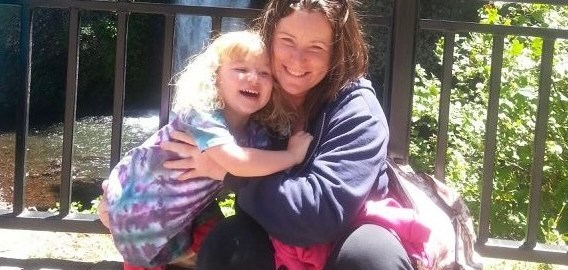
(Vesta).
And this is me: (Harvey).
And when she’s this: Vesta and I’m with you and we’re with him, she’ll know what to do, too.
Goodbye again, Papa. I love you. And thank you. For all of it.
Love,
(Monica)
 Dear Harvey